On this page
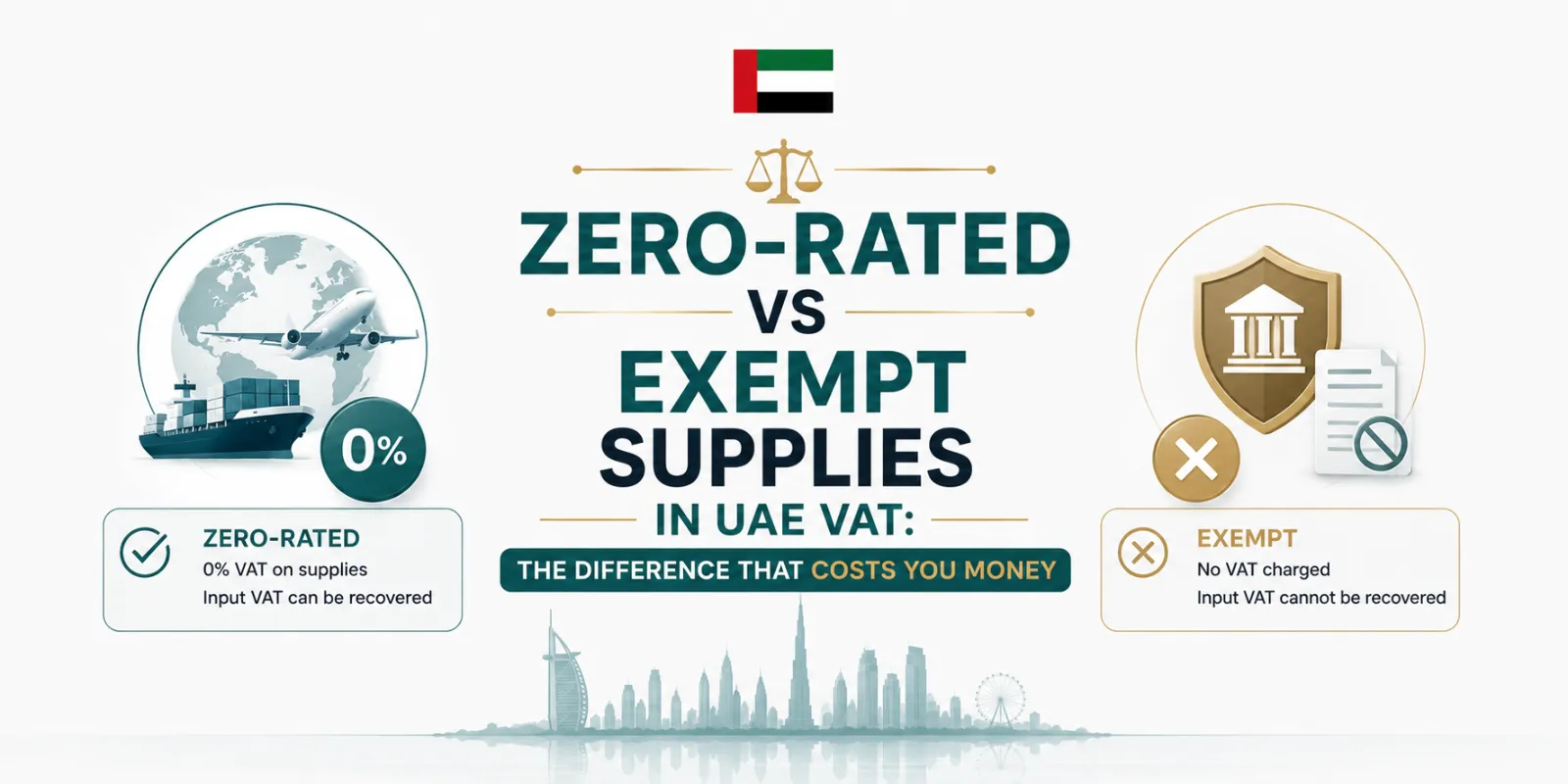
Zero-rated and exempt supplies both mean charging no VAT to your customer — the difference is what happens to your costs: zero-rated suppliers recover the input VAT on their purchases in full, while exempt suppliers cannot recover input VAT at all. Get the classification wrong and you either over-claim (an FTA penalty risk) or silently absorb 5% on every cost you could have recovered.
Zero-rated
Charge 0%, recover input VAT.
Exempt
Charge nothing, recover nothing.
This guide gives the complete UAE lists for both categories, the real-estate rules that confuse everyone, and how apportionment works when you make both kinds of supply. It's part of our complete UAE VAT guide cluster.
The distinction in one table
| Zero-rated (0%) | Exempt | |
|---|---|---|
| VAT charged to customer | 0% | None |
| Counts as a taxable supply? | Yes | No |
| Input VAT on related costs | Fully recoverable | Not recoverable |
| Counts toward the AED 375,000 registration threshold? | Yes | No |
| Shown on VAT 201 | Box 4 | Box 5 |
| Legal basis | Article 45, VAT Decree-Law | Article 46, VAT Decree-Law |
Key takeaway
Zero-rated is a privilege; exempt is a limitation. A business making only zero-rated supplies gets refunds every period. A business making only exempt supplies isn't even entitled to register — and eats 5% on all its costs.
Complete list: zero-rated supplies
Under Article 45 of the VAT Decree-Law and the Executive Regulations:
- Exports of goods outside the GCC implementing states (with official and commercial evidence)
- Exports of services — broadly, services supplied to recipients outside the UAE, subject to conditions tightened by the 2024 Executive Regulation updates
- International transportation of passengers and goods, and associated services
- Certain means of transport — commercial aircraft, vessels, and vehicles designed to carry 10+ passengers — and related goods and services
- Crude oil and natural gas
- First supply of residential buildings within 3 years of completion (sale or lease)
- First supply of buildings converted from non-residential to residential, and buildings for charities
- Qualifying education — curricula-recognised nurseries, schools and higher education institutions, and closely related goods/services
- Qualifying healthcare — preventive and basic treatment by licensed providers, and related medicines/equipment per Cabinet lists
- Investment precious metals — gold, silver, platinum of 99%+ purity in tradable form
Complete list: exempt supplies
Under Article 46:
- Financial services remunerated by margin or spread (interest, currency spreads, life insurance) — fee-based financial services remain 5%. Following Cabinet Decision No. 100 of 2024, investment fund management and transfers/conversions of virtual assets are also exempt (virtual assets with retrospective effect to 2018)
- Residential buildings — every sale or lease after the zero-rated first supply
- Bare land — land with no completed or partially completed buildings or civil works
- Local passenger transport — taxis, buses, metro, abras, domestic flights by road/water/air within the UAE
Real estate: the lifecycle everyone gets wrong
- Developer's first supply of a new residential building (within 3 years of completion): zero-rated. The developer recovers all construction input VAT — this is deliberate policy to keep housing costs down.
- Every later sale or lease of that residential building: exempt. Landlords of apartments recover nothing on maintenance, agent fees or refurbishment.
- Commercial property: 5% throughout — sales, leases, and hotel/serviced accommodation.
- Bare land: exempt. Developed land: 5%. Whether "civil works" exist on a plot has been the subject of real disputes — get advice before large land deals.
A mixed-use tower (retail podium + residential floors) therefore produces standard-rated, exempt and possibly zero-rated supplies from one asset — which is exactly where apportionment comes in.
Partial exemption and apportionment
A business making both taxable and exempt supplies recovers input VAT in three buckets:
- Directly attributable to taxable supplies → recover in full
- Directly attributable to exempt supplies → no recovery
- Overheads used for both (rent, audit fees, software) → recover the taxable proportion, using the standard input-based apportionment method (or an FTA-approved special method for complex businesses), with an annual wash-up adjustment after year-end
Worked example
A landlord earns AED 3M from commercial units (5%) and AED 1M from residential units (exempt). Overhead input VAT for the year is AED 80,000. Recoverable share ≈ 3M / 4M = 75% → AED 60,000 recoverable, AED 20,000 permanently lost to the exempt activity.
Why the difference also matters for registration
Zero-rated supplies count toward the AED 375,000 registration threshold; exempt supplies don't. An exporter with AED 2M of foreign sales must register (though it may apply for an exception from registration if all its supplies are zero-rated); a residential landlord with AED 2M of rent cannot register at all on that income alone.
Classifying supplies wrong is expensive in both directions
Stevva Tax reviews your revenue streams, fixes classifications, and builds the apportionment workings the FTA expects to see.
Get a VAT classification review →FAQs
What is the difference between zero-rated and exempt in UAE VAT?
Both charge the customer no VAT, but zero-rated supplies are taxable at 0% — so the supplier recovers input VAT and the income counts toward the registration threshold — while exempt supplies carry no recovery rights and don't count toward the threshold.
Are exports zero-rated or exempt in the UAE?
Zero-rated, provided export documentation is retained. That means exporters recover the VAT on their costs and typically file refund-position returns.
Is residential rent exempt from VAT in the UAE?
Yes — sales and leases of residential property are exempt, except the first supply within three years of completion, which is zero-rated.
Can a business making only exempt supplies register for VAT?
No. With no taxable supplies it doesn't meet the registration conditions — and consequently cannot recover any input VAT.
What is partial exemption?
The position of a business making both taxable and exempt supplies. It must apportion input VAT on shared costs, recovering only the proportion attributable to taxable activity, with an annual adjustment.
Do zero-rated sales count toward the AED 375,000 threshold?
Yes, in full. Exempt supplies do not. A business making solely zero-rated supplies may request an exception from registration despite crossing the threshold.
Are financial services exempt in the UAE?
Margin-based financial services (interest, spreads, life insurance) are exempt; explicit fee-based services are standard-rated at 5%. Fund management and virtual asset transfers became exempt under the November 2024 Executive Regulation changes.
How Stevva can help
Getting the zero-rated versus exempt classification wrong costs real money through lost input VAT recovery or incorrect apportionment. Stevva Tax reviews supply classifications, builds apportionment methodologies and handles the related filings through our VAT advisory and compliance service. Real estate businesses in particular benefit from a one-off review of their supply mix.
Not sure how a specific supply should be treated? Message us on WhatsApp at +971 50 932 1257.
Sources: Federal Decree-Law No. 8 of 2017, Articles 45–46, and amendments; Cabinet Decision No. 100 of 2024 (Executive Regulations); FTA guides on real estate, financial services and input tax apportionment (tax.gov.ae).
General information, not tax advice.

Hemavathi writes on UAE VAT and indirect tax for Stevva Tax, covering registration, compliance and the e-invoicing transition for businesses across the mainland and free zones.
Updated August 2026. This guide is general information, not tax advice.