On this page
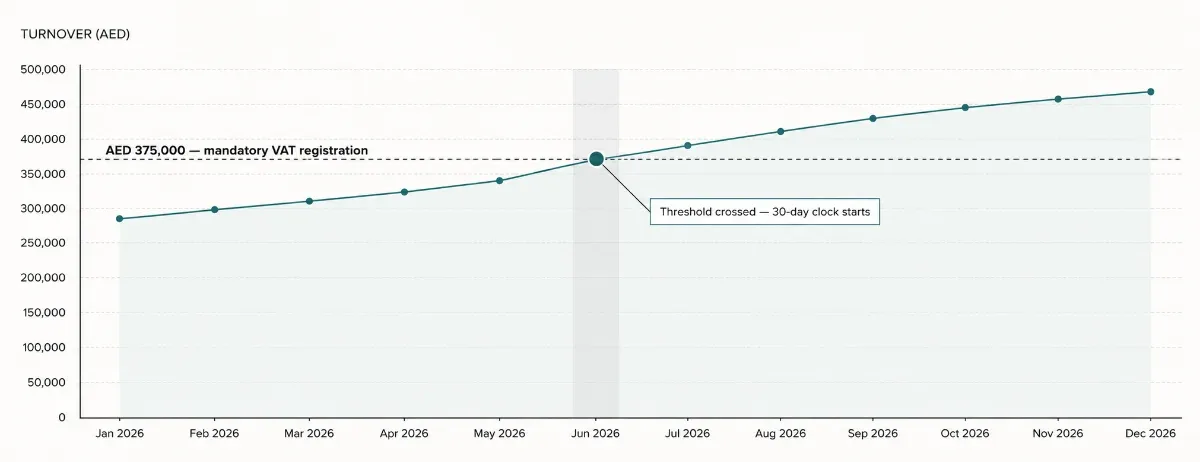
A UAE business must register for VAT within 30 days once its taxable supplies and imports exceed AED 375,000 over the previous 12 months (or are expected to in the next 30 days) — and late registration carries a fixed AED 10,000 penalty. Registration is free, fully online through the Federal Tax Authority's EmaraTax portal, and ends with the issue of your Tax Registration Number (TRN).
This guide covers who must register, who may register voluntarily, the exact documents to prepare, and the EmaraTax process step by step. For the full picture of how VAT works, see our complete UAE VAT guide.
Who must register — the thresholds
| Registration type | Threshold | Who |
|---|---|---|
| Mandatory | Taxable supplies + imports > AED 375,000 in the past 12 months, or expected within the next 30 days | All UAE-resident businesses, mainland and free zone |
| Voluntary | Taxable supplies + imports (or taxable expenses) > AED 187,500 | Startups and smaller businesses that want input VAT recovery and a TRN |
| Non-residents | No threshold | Any non-resident making taxable supplies in the UAE where no other party accounts for the VAT |
Free zone companies register on exactly the same thresholds as mainland businesses — a free zone licence is not a VAT exemption, and even businesses inside designated zones must register once they cross the threshold.
Why register voluntarily? Two common reasons: recovering VAT on setup and pre-revenue costs, and credibility — many corporate customers expect a TRN on your invoices before onboarding you as a supplier.
Calculating whether you've crossed AED 375,000
The threshold test counts your taxable turnover: standard-rated supplies + zero-rated supplies + imports of goods and services + supplies you must reverse-charge. It excludes exempt supplies (like residential rent) and out-of-scope income.
Worked example
A design studio invoices AED 290,000 to UAE clients (5%) and AED 110,000 to overseas clients (zero-rated exports). Taxable turnover = AED 400,000 — over the threshold, even though only AED 290,000 carried VAT. The studio must register within 30 days.
Watch the rolling test: it's the previous 12 months on a rolling basis, not your financial year, plus a forward test if you expect to cross within 30 days (a signed large contract can trigger this).
Documents required
- Trade licence (all licences if you have several)
- Passport copies and Emirates IDs of the owner(s)/partners and the authorised signatory
- Proof of authorisation (MOA, or power of attorney for the signatory)
- Contact details and registered business address
- Bank account details — an IBAN letter from your bank
- Turnover evidence: financial statements, audit report, or a signed turnover declaration with supporting invoices
- Customs registration number(s), if you import or export
- Details of expected turnover, business activities and GCC dealings (declared within the form)
Step-by-step: registering on EmaraTax
- Create your EmaraTax account. Sign up at eservices.tax.gov.ae with your email or UAE Pass and verify your login.
- Create the taxable person profile. One EmaraTax account can hold several taxable persons — add the legal entity that's registering.
- Start the VAT registration application. Select the taxable person → Register for VAT.
- Complete the form sections. Entity details (legal type, trade licence), identification of owners and the authorised signatory, contact and address details, bank details, business relationships (other directorships/partnerships), and the "About the VAT registration" section: activities, actual and expected turnover, imports/exports, and customs registrations.
- Upload your documents in the required formats and sizes.
- Review and submit. Check every figure — mismatches between declared turnover and your uploaded evidence are the most common cause of rejection and resubmission loops.
- Respond to FTA queries promptly. The FTA may ask for clarifications; the application clock pauses until you answer.
After you apply: timelines and your TRN
The FTA typically processes complete applications within about 20 business days — incomplete ones take longer because each query resets the review. On approval you receive your 15-digit Tax Registration Number (TRN) and VAT registration certificate through EmaraTax.
From your effective date of registration you must charge 5% VAT on taxable supplies, issue compliant tax invoices, and file returns by the 28-day deadline. Your customers can (and should) verify your TRN on the FTA website — and you should verify your suppliers' TRNs before recovering input VAT on their invoices.
Key takeaway
Register on the forward test the moment a contract will push you over AED 375,000 — waiting for the invoices to land is how businesses end up both AED 10,000 poorer and retrospectively liable for VAT they never collected from customers.
Tax groups: registering related companies together
Two or more UAE-established entities under common ownership or control can apply to register as a single VAT tax group (Article 14 of the VAT Law): one TRN, one consolidated return, and supplies between group members generally fall outside the scope of VAT. It simplifies compliance for holding structures — but every member is jointly and severally liable for the group's VAT, so the decision deserves advice.
Register for VAT without the rejection loops
Stevva Tax prepares and files EmaraTax registrations that get approved first time — thresholds checked, documents right, turnover evidence reconciled.
Get registered →FAQs
What is the VAT registration threshold in the UAE?
Mandatory registration applies once taxable supplies and imports exceed AED 375,000 over the previous 12 months or are expected to within the next 30 days. Voluntary registration is available above AED 187,500.
How long does VAT registration take in the UAE?
Typically around 20 business days for a complete application on EmaraTax. Applications with missing or inconsistent documents take longer due to FTA queries.
How much does VAT registration cost?
Registration itself is free of government charges on EmaraTax. The AED 10,000 cost people associate with registration is the penalty for registering late.
Do free zone companies need to register for VAT?
Yes — the same AED 375,000 threshold applies to free zone and designated-zone companies as to mainland businesses.
Can I register for VAT before reaching the threshold?
Yes, voluntarily, once taxable supplies, imports or taxable expenses exceed AED 187,500 — commonly done to recover VAT on startup costs.
Does zero-rated income count toward the registration threshold?
Yes. Zero-rated supplies (such as exports) are taxable supplies at 0% and count in full toward the AED 375,000 test. Exempt supplies do not count.
What is a TRN?
The 15-digit Tax Registration Number issued on approval. It must appear on all your tax invoices and can be verified publicly on the FTA website.
What happens if I register late?
A fixed AED 10,000 penalty, plus liability for the VAT you should have charged from the date you were required to register — often unrecoverable from past customers.
How Stevva can help
Stevva Tax registers businesses for VAT on EmaraTax as part of our VAT advisory and compliance service: threshold assessment, document preparation, the application itself and the first return once your TRN is issued. If you are forming the company at the same time, our free zone and mainland setup teams coordinate so registration follows licensing without a gap.
Close to the threshold or already past it? Message us on WhatsApp at +971 50 932 1257 and we will tell you whether and when to register.
Sources: Federal Decree-Law No. 8 of 2017 and amendments; Cabinet Decision No. 100 of 2024 (Executive Regulations); FTA VAT registration guides and EmaraTax user manuals (tax.gov.ae); Cabinet Decision No. 49 of 2021 (penalties).
General information, not tax advice.

Hemavathi writes on UAE VAT and indirect tax for Stevva Tax, covering registration, compliance and the e-invoicing transition for businesses across the mainland and free zones.
Updated August 2026. This guide is general information, not tax advice.