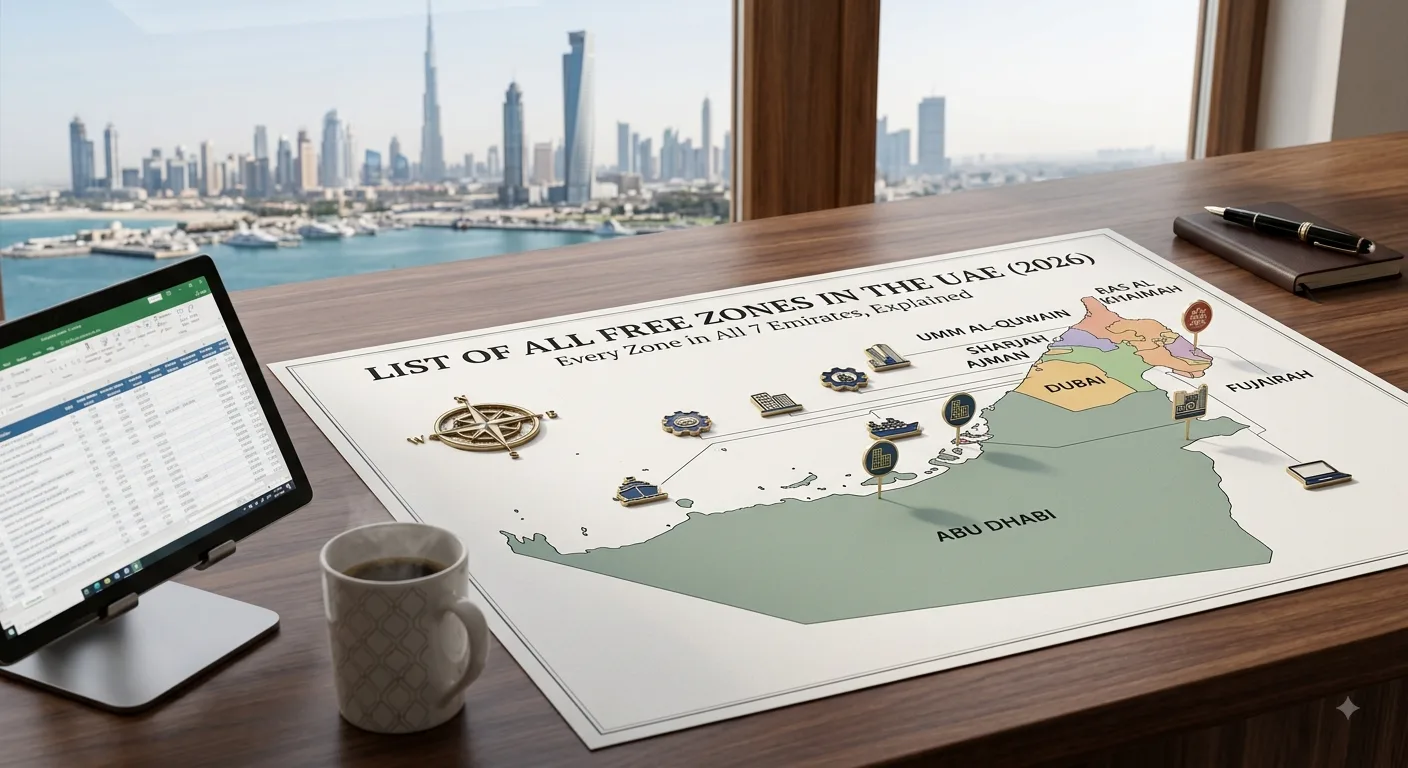
The UAE has more than 40 free zones, commonly counted at around 45–46 as of 2026, spread across all seven emirates: Dubai, Abu Dhabi, Sharjah, Ajman, Ras Al Khaimah, Fujairah and Umm Al Quwain. Each zone is run by its own free zone authority, offers 100% foreign ownership with full repatriation of capital and profits, and is typically built around specific industries: from finance (DIFC, ADGM) and commodities (DMCC) to media (Shams, twofour54) and logistics (JAFZA, KEZAD).
This guide lists every major free zone by emirate, what each specialises in, and how to shortlist the right one for your business.
What is a UAE free zone?
A free zone is a designated economic area governed by its own free zone authority, with its own company registrar, licensing rules and, in the case of DIFC and ADGM, even its own legal system based on common law. Free zones were created to attract foreign investment, and the core benefits are consistent across all of them:
- 100% foreign ownership: no local partner required
- Full repatriation of capital and profits
- Customs advantages: duty exemptions on imports into the zone and re-exports
- 0% corporate tax on qualifying income for entities that meet Qualifying Free Zone Person (QFZP) conditions under the UAE Corporate Tax Law
- Fast, largely digital company formation, often without a physical office (flexi-desk packages)
The trade-off: a free zone company is licensed to operate within its zone and internationally; selling directly into the UAE mainland market generally requires a mainland distributor, a branch, or customs duty on goods entering the mainland. If your customers are primarily onshore UAE, weigh a mainland licence against a free zone. Stevva advises on both, and on offshore structures where a holding vehicle fits better.
Note on the count: Sources cite anywhere from 40 to 50+ UAE free zones. The number genuinely shifts as new zones launch (e.g., RAK Digital Assets Oasis in 2023) and others merge (e.g., KIZAD and ZonesCorp consolidating into KEZAD). This list covers the zones that matter for company formation in 2026.
Free zones in Dubai
Dubai · 25+ zonesDubai has the largest concentration: 25+ zones. Several operate under umbrella authorities: the TECOM Group zones (Internet City, Media City and others), the Dubai Integrated Economic Zones Authority (DIEZ), and DWTC.
Finance, trade & commodities
- DIFC (Dubai International Financial Centre)
Banking, asset management, fintech; its own common-law courts.
- DMCC (Dubai Multi Commodities Centre)
Commodities, trading, crypto; repeatedly named the world's top free zone by fDi magazine.
- JAFZA (Jebel Ali Free Zone)
The UAE's original mega-zone; logistics, manufacturing and trade at Jebel Ali Port.
- DWTC Free Zone (Dubai World Trade Centre)
Events, trade, and a growing digital-assets ecosystem.
- Meydan Free Zone
Cost-efficient digital licences for trading, e-commerce and consulting.
- IFZA (International Free Zone Authority)
One of the most popular value zones for SMEs, consultants and general trading. Stevva is an IFZA partner: read our IFZA setup guide.
- Dubai Auto Zone
Automotive trade, parts and re-export.
- Gold & Diamond Park
Precious metals and jewellery (JAFZA-affiliated).
Technology & digital (DIEZ + TECOM)
- Dubai Silicon Oasis (DSO)
Technology, electronics, startups (DIEZ).
- Dubai Airport Free Zone (DAFZ)
Aviation-linked trade and light industry at DXB (DIEZ).
- Dubai CommerCity
The region's first e-commerce-dedicated zone (DIEZ).
- Dubai Internet City (DIC)
The Gulf's flagship tech cluster; home to global software and internet firms.
- Dubai Outsource City
BPO, shared services and call centres.
Media, design & education (TECOM)
- Dubai Media City (DMC)
Media, marketing, publishing.
- Dubai Studio City
Film, TV and production facilities.
- Dubai Production City
Printing, packaging and publishing.
- Dubai Design District (d3)
Fashion, design and creative brands.
- Dubai Knowledge Park
HR, training and professional education.
- Dubai International Academic City (DIAC)
University campuses and edtech.
Science, health & specialist
- Dubai Science Park
Life sciences, labs and pharma.
- Dubai Healthcare City (DHCC)
Clinics, hospitals and medical education.
- Dubai South
Aviation, logistics and e-commerce around Al Maktoum Airport and Expo City.
- Dubai Maritime City
Shipping, marine services and yacht industries.
- International Humanitarian City (IHC)
Humanitarian logistics and NGOs.
- DUQE Free Zone
Startup-focused zone aboard the QE2 at Port Rashid.
Dubai's hidden rule: your address decides your licence
Here's what most free zone lists never tell you: many of Dubai's free zones are not fenced industrial parks. They are ordinary-looking neighbourhoods you can walk into freely, yet operating a business there requires that specific zone's licence, not a standard Dubai mainland (DET) licence.
- Jumeirah Lakes Towers (JLT). All 79 towers of this residential-and-office district sit inside DMCC's jurisdiction. To lease an office and operate in JLT, you need a DMCC licence; a mainland licence won't do. (Adding to the layered picture: building and fit-out approvals in JLT go through Trakhees, even though company licensing is DMCC.)
- TECOM / DDA districts. Internet City, Media City, Knowledge Park, Studio City, Production City, Science Park, d3 and Barsha Heights are open urban districts regulated by the Dubai Development Authority. A training institute in Knowledge Park needs a Dubai Knowledge Park licence; an agency in Media City needs a Dubai Media City licence. Each district licenses its own tenants.
- Trakhees (PCFC) areas. Trakhees, the licensing and regulatory arm of Dubai's Ports, Customs & Free Zone Corporation, issues commercial licences across the Nakheel and Dubai World communities: Palm Jumeirah, International City, Discovery Gardens, Al Furjan, the Ibn Battuta area, Dubai Maritime City and the Port Rashid waterfront. A retail unit or restaurant in these communities operates on a Trakhees licence, not a mainland one.
- DIFC district. Even non-financial businesses (the restaurants, galleries and cafés of Gate Avenue) are licensed by the DIFC Authority because the district is its own jurisdiction with its own laws.
- Dubai South & Expo City, Dubai Healthcare City. Each licenses businesses within its own boundaries through its own authority.
Why it matters in practice: the licence determines your regulator, your renewal costs, your visa process, and whether your lease is even valid. Signing a tenancy in JLT with a mainland licence (or vice versa) is one of the most common and expensive setup mistakes we see. Dubai's Dubai Unified Licence (DUL) now gives every business a single emirate-wide identifier, and dual-licensing schemes are expanding, but the underlying rule stands: check which authority governs your intended address before you choose your licence, not after.
For a goods business there is a second question: whether the zone is a designated zone. JAFZA and DAFZA are on the FTA's VAT list; DMCC, IFZA, Meydan and Shams are not, and under FTA Public Clarification TAXP010 (October 2026) that now decides whether distribution income can be taxed at 0% as a Qualifying Free Zone Person.
Key takeaway: In Dubai, geography is jurisdiction. Pick the premises and the licence together, never separately.
Free zones in Abu Dhabi
Abu Dhabi · 8 zonesThe capital runs fewer, larger zones, roughly 8, with a focus on finance, industry and media.
- ADGM (Abu Dhabi Global Market)
International financial centre on Al Maryah Island with its own common-law framework; finance, funds, fintech and increasingly holding structures.
- KEZAD (Khalifa Economic Zones Abu Dhabi)
The emirate's industrial and logistics giant under AD Ports Group, formed from KIZAD and ZonesCorp.
- Masdar City Free Zone
Clean energy, sustainability and smart-city technology.
- twofour54 / Yas Creative Hub
Media, gaming and content production.
- Abu Dhabi Airport Free Zone (ADAFZ)
Aviation, aerospace and airport-linked logistics.
- AD Ports Free Zone areas
Port-adjacent trade and marine services under AD Ports Group.
Free zones in Sharjah
Sharjah · 6–7 zonesSharjah pairs genuine industrial capacity with some of the UAE's most affordable licences: around 6–7 zones.
- Shams (Sharjah Media City)
Media, creative, e-commerce and consulting licences from AED 5,750; one of the most cost-effective setups in the UAE. Read Stevva's complete Shams setup guide →
- SAIF Zone (Sharjah Airport International Free Zone)
Trade, light manufacturing and logistics beside Sharjah Airport.
- Hamriyah Free Zone (HFZA)
Heavy industry, oil & gas services and manufacturing at Hamriyah Port.
- SPC Free Zone (Sharjah Publishing City)
The world's first publishing-dedicated zone, now issuing broad commercial licences.
- SRTIP (Sharjah Research, Technology & Innovation Park)
R&D, greentech and deep-tech startups.
- Sharjah Healthcare City
Medical facilities and health services.
Free zones in Ajman
Ajman · 3 zones- Ajman Free Zone (AFZ)
One of the UAE's oldest budget-friendly zones; trading, services and light industry.
- Ajman Media City Free Zone (AMCFZ)
Low-cost licences for media, consulting and online businesses.
- Ajman NuVentures Centre Free Zone (ANCFZ)
Newer entrant offering competitively priced commercial and service licences with fast issuance.
Free zones in Ras Al Khaimah
RAK · 4 zones- RAKEZ (Ras Al Khaimah Economic Zone)
One of the largest multi-sector zones in the region; SME packages through to industrial plots at highly competitive rates.
- RAK Digital Assets Oasis (RAK DAO)
Launched 2023; the world's first free zone dedicated to digital assets and Web3 companies.
- RAK Maritime City
Port-based marine, shipping and industrial operations.
- RAK ICC (RAK International Corporate Centre)
The emirate's registry for offshore/international business companies (holding and asset-protection structures rather than operating licences). See Stevva's offshore company setup guide.
Free zones in Fujairah
Fujairah · 3 zones- Fujairah Free Zone (FFZ)
Trade, shipping and warehousing with direct access to Fujairah Port on the Indian Ocean, outside the Strait of Hormuz.
- Fujairah Creative City
Affordable licences for media, design, consulting and freelancers.
- FOIZ (Fujairah Oil Industry Zone)
One of the world's largest oil-storage and bunkering hubs.
Free zones in Umm Al Quwain
UAQ · 1 zone- UAQ FTZ (Umm Al Quwain Free Trade Zone)
Among the cheapest licences in the UAE; popular with micro-businesses, freelancers and startups that don't need premium addresses.
Quick picks by business type
| Your business | Zones to shortlist first |
|---|---|
| Consulting / professional services | IFZA, Shams, Meydan, RAKEZ |
| E-commerce | Dubai CommerCity, IFZA, Shams, Meydan |
| Media & content creators | Shams, twofour54, Dubai Media City, Fujairah Creative City |
| Trading & import/export | JAFZA, DMCC, SAIF Zone, RAKEZ |
| Manufacturing & industrial | KEZAD, Hamriyah, JAFZA, RAKEZ |
| Finance, funds & fintech | DIFC, ADGM |
| Crypto & Web3 | RAK DAO, DMCC (Crypto Centre), DWTC |
| Tech startups | DSO, Dubai Internet City, SRTIP, Masdar City |
| Healthcare | Dubai Healthcare City, Sharjah Healthcare City |
| Logistics & shipping | JAFZA, Dubai South, KEZAD, Fujairah FZ |
| Lowest-budget setup | UAQ FTZ, Ajman FZ, Shams, ANCFZ |
| Holding / asset protection | ADGM, DIFC, RAK ICC (offshore) |
How to choose the right free zone
Price matters, but five other factors decide whether a zone actually fits:
- Activity coverage. Every zone maintains its own approved activity list. Confirm your exact activity, and any you'll add later, is licensable before paying anything.
- Visa quota and cost. Zones tie visa allocations to your package or office size. If you'll sponsor staff or family, model the visa cost per person, not just the licence fee. Our tools & calculators help you estimate the full picture. If your zone is outside Dubai, visas also require an active e-channel registration first.
- Banking acceptance. UAE banks weigh the free zone's reputation during corporate account opening. A slightly pricier, better-known zone can pay for itself in smoother banking.
- Tax position. The 0% free zone corporate tax rate applies only to Qualifying Free Zone Persons earning qualifying income, and QFZP status is incompatible with Small Business Relief. Where you'll earn your revenue (in-zone, abroad, or mainland) should shape the choice.
- Physical needs. Flexi-desk is fine for consultants; traders need warehousing near the right port; regulated activities may require physical premises.
Designated zones and VAT: a handful of fenced zones (such as JAFZA, KEZAD areas and SAIF Zone) are "designated zones" by Cabinet Decision, where certain goods transactions sit outside the scope of UAE VAT. Service businesses and non-fenced zones follow normal VAT rules; registration is required once taxable turnover exceeds AED 375,000.
Key takeaway: The "best" free zone is the cheapest one that covers your activity, gives you the visas you need, and is respected by your bank. That's rarely the first zone an Instagram ad shows you.
45+ zones, one right answer for your business.
Stevva compares licence costs, visa quotas, banking acceptance and tax treatment across every UAE free zone, and handles the full setup once you choose.
Get a free zone recommendationFrequently asked questions
How many free zones are there in the UAE?
The UAE has more than 40 free zones, with most 2026 counts landing around 45–46, across all seven emirates. The exact number changes as new zones launch and existing ones merge under umbrella authorities such as DIEZ, TECOM and KEZAD.
Which emirate has the most free zones?
Dubai, with over 25 free zones ranging from global heavyweights like DIFC, DMCC and JAFZA to sector clusters for tech, media, design, healthcare and e-commerce.
What is the cheapest free zone in the UAE?
The most affordable licences are typically found in the northern emirates: UAQ Free Trade Zone, Ajman Free Zone, Ajman Media City, Fujairah Creative City, and Sharjah's Shams (from AED 5,750). Dubai's IFZA and Meydan are the leading value options within Dubai. Total cost depends on visas and office requirements, not just the licence.
What is the best free zone in the UAE?
There is no single best zone; it depends on your activity. DIFC and ADGM lead for financial services, DMCC for trading and commodities, JAFZA and KEZAD for logistics and industry, Shams and twofour54 for media, and IFZA, Meydan and RAKEZ for cost-efficient SME setups.
Can a free zone company do business in mainland UAE?
Not directly, in most cases. Free zone companies trade within their zone and internationally; reaching mainland customers generally requires a local distributor, a mainland branch, or paying customs duty on goods entering the mainland. Some zones offer dual-licensing arrangements with their emirate's economic department.
Do free zone companies pay corporate tax?
Free zone entities that meet the Qualifying Free Zone Person (QFZP) conditions pay 0% corporate tax on qualifying income and 9% on non-qualifying income. Entities that don't meet QFZP conditions are taxed like mainland companies, though they may then be eligible for Small Business Relief if revenue is AED 3 million or less.
What is the difference between a free zone and offshore company?
A free zone company holds a licence to operate a real business from the UAE (with visas and premises). An offshore company, registered through RAK ICC or JAFZA Offshore, is a non-resident holding vehicle: it cannot rent UAE offices or sponsor visas and is used for asset holding and international structuring.
Do I need a physical office in a free zone?
Usually not to start. Most zones offer flexi-desk or shared workspace packages that satisfy the office requirement for small licences, with visa quotas scaling as you upgrade to dedicated offices or warehouses.
How long does free zone company setup take?
Straightforward cases in zones like IFZA, Shams or RAKEZ are typically licensed within 2–5 working days once documents are in order. Regulated activities (finance, healthcare, education) take longer due to additional approvals.
Do I need a DMCC licence to open a business in JLT?
Yes. Jumeirah Lakes Towers is entirely within DMCC's free zone jurisdiction, so any company leasing and operating in JLT's towers must hold a DMCC licence. A Dubai mainland licence does not permit you to set up in JLT, and the reverse also applies.
What is a Trakhees licence and where is it required?
Trakhees is the licensing and regulatory arm of Dubai's Ports, Customs and Free Zone Corporation (PCFC). It issues commercial licences for businesses operating in PCFC, Dubai World and Nakheel-developed areas, including Palm Jumeirah, International City, Discovery Gardens, Al Furjan, the Ibn Battuta area and Dubai Maritime City. Retail outlets, restaurants and services physically located in these communities are licensed by Trakhees rather than Dubai's mainland authority.
Which free zones are "designated zones" for VAT?
Designated zones are specific fenced free zones (such as JAFZA, KEZAD areas and SAIF Zone) listed by Cabinet Decision, where certain goods transactions can be treated as outside the scope of UAE VAT. Service businesses and non-fenced zones follow normal VAT rules; registration is required once taxable turnover exceeds AED 375,000.
Set up your free zone company with Stevva
From choosing the zone to licence issuance, visas and bank account opening, Stevva manages UAE free zone setups end to end, with transparent pricing.
Book a free consultationHow Stevva can help
Shortlisting a free zone is the start; licensing, visas, bank account opening and the ongoing compliance calendar follow. Stevva Incorporations handles free zone company setup end to end, with a fixed price agreed before we start, and our tax team can confirm whether your chosen zone and activity qualify for 0% corporate tax under our corporate tax advisory service.
Tell us what you plan to do and where your customers are, and we will recommend two or three zones that fit. Message us on WhatsApp at +971 50 932 1257.
Sources: the official UAE Government portal (u.ae), Doing business in a free zone; individual free zone authority websites (DMCC, DIFC, ADGM, JAFZA, KEZAD, RAKEZ, Shams, IFZA and others); Trakhees / Ports, Customs & Free Zone Corporation (pcfc.ae); Dubai Development Authority; UAE Corporate Tax Law (Federal Decree-Law No. 47 of 2022) and related Cabinet Decisions on Qualifying Free Zone Persons and designated zones. Zone counts, prices and packages change frequently; verify current offers with the relevant free zone authority or with Stevva before committing.

Rozmina Qureshi
Rozmina is an Operations Executive at Stevva Incorporations, working on free zone setups, licensing and visa processing across the UAE. She keeps this list current as zones launch, merge and reprice, so the date near the title is the date it was last verified.
Last updated August 2026. This article is general information, not regulated tax or legal advice. Zone counts, prices and packages change; verify current requirements with the relevant free zone authority or speak to Stevva before acting.